D-Day anniversary: How Americans heard the news, and the speech that was never given
Even American news outlets didn’t believe it, to begin with.
German news agencies had broken the story early on the morning of June 6, 1944, that Nazi forces along the northwestern coast of France were under attack by Allied forces — the beginning of the long-rumored invasion of Europe.
American news outlets would report that it was unlikely that the invasion had begun — one CBS commentator noted that the Germans had not broadcast the news to its own people.
But, as the world would learn during the hours that followed, the reports were all too true. While CBS, NBC and others reported on the German reports, news of the invasion broke in the United States at 3:32 a.m. ET.
Gen. Dwight David Eisenhower’s Order of the Day — which was a message recorded for the men going into the invasion — was broadcast over American radio stations.
Here’s how Americans and others around the world heard the news of the invasion.
How the troops were told by Eisenhower
Here is how General Dwight D. Eisenhower’s Order of the Day, posted early on June 6, 1944, was posted to the Allied troops:
Supreme Headquarters
Allied Expeditionary Force
“Soldiers, Sailors, and Airmen of the Allied Expeditionary Force!
“You are about to embark upon the Great Crusade, toward which we have striven these many months. The eyes of the world are upon you. The hope and prayers of liberty-loving people everywhere march with you. In company with our brave Allies and brothers-in-arms on other Fronts, you will bring about the destruction of the German war machine, the elimination of Nazi tyranny over the oppressed peoples of Europe, and security for ourselves in a free world.
“Your task will not be an easy one. Your enemy is well-trained, well equipped and battle-hardened. He will fight savagely.
“But this is the year 1944! Much has happened since the Nazi triumphs of 1940-41. The United Nations have inflicted upon the Germans great defeats, in open battle, man-to-man. Our air offensive has seriously reduced their strength in the air and their capacity to wage war on the ground. Our Home Fronts have given us an overwhelming superiority in weapons and munitions of war and placed at our disposal great reserves of trained fighting men. The tide has turned! The free men of the world are marching together to Victory!
“I have full confidence in your courage, devotion to duty and skill in battle. We will accept nothing less than full Victory!
“Good luck! And let us beseech the blessing of Almighty God upon this great and noble undertaking.”
How did the Americans begin to hear the news?
The news began to leak out around 12:30 a.m. ET (called “Eastern War Time” then) on June 6. German radio reported that Allied forces were bombing areas along the French coast.
The first reports from American media warned that the information could be a German trick and that nothing had been confirmed.
CBS’ Bob Trout told listeners, “Frankly, we don’t know at this time whether those German news agency reports that the invasion has begun are true or not. However, the scarcity of any details from the Germans in these two hours after the first announcement do throw very strong doubt on the possible truth of the German story. … However, late last night three German news agencies flashed word that Allied paratroops were spilling out of the skies over the Normandy peninsula of France. And that our landing craft has started coming ashore in the Le Havre area, just 80 miles across the English Channel from Britain.”
Here is the audio from news reports in the early hours of June 6. The confirmed news of the invasion comes in at 49:56 in the video.
From the AP, a report of what happened that day
The Associated Press had correspondents on the ground with troops landing on the beaches of Normandy in addition to reporters in various locations in England. Here is the story that was filed about the invasion. It ran in newspapers around the world on June 8, 1944.
From the battle itself
American journalist George Hick broadcast from the deck of the USS Ancon what he saw as the invasion got underway. “…You see the ships lying in all directions, just like black shadows on the grey sky. Now planes are going overhead. … Heavy fire now just behind us … bombs bursting on the shore and along in the convoys.”
Hicks had technical trouble with the live broadcast. Eventually, the broadcast was replayed. It sounded like this:
Here, from CBS war correspondent Charles Collingswood shares a report from a ship off the coast of Normandy
The BBC reporting
To hear the reports on the BBC from that day, click here to see their D-Day reports page. There are links to the broadcasts during the day.
Ernie Pyle saw the horrors of what the invasion brought
Click here to read famed war reporter Ernie Pyle’s description of the scene on the beaches of northeast France, a day later. The column was published on June 12. Pyle wrote two more columns about the invasion. You can read them here and here.
At home, FDR announces the invasion to the nation and prays
Historians say that President Franklin Roosevelt knew only minutes before the American public did that the invasion of Europe had begun.
Roosevelt took to the radio airwaves on the night of June 6 to talk to the American people and offer a prayer for the success of the invasion.
Here is the text of that prayer:
“My fellow Americans: Last night, when I spoke with you about the fall of Rome, I knew at that moment that troops of the United States and our allies were crossing the Channel in another and greater operation. It has come to pass with success thus far.
“And so, in this poignant hour, I ask you to join with me in prayer:
“Almighty God: Our sons, pride of our Nation, this day have set upon a mighty endeavor, a struggle to preserve our Republic, our religion, and our civilization, and to set free a suffering humanity.
“Lead them straight and true; give strength to their arms, stoutness to their hearts, steadfastness in their faith.
“They will need Thy blessings. Their road will be long and hard. For the enemy is strong. He may hurl back our forces. Success may not come with rushing speed, but we shall return again and again; and we know that by Thy grace, and by the righteousness of our cause, our sons will triumph.
“They will be sore tried, by night and by day, without rest until the victory is won. The darkness will be rent by noise and flame. Men’s souls will be shaken with the violences of war.
“For these men are lately drawn from the ways of peace. They fight not for the lust of conquest. They fight to end conquest. They fight to liberate. They fight to let justice arise, and tolerance and good will among all Thy people. They yearn but for the end of battle, for their return to the haven of home.
“Some will never return. Embrace these, Father, and receive them, Thy heroic servants, into Thy kingdom.
“And for us at home — fathers, mothers, children, wives, sisters, and brothers of brave men overseas — whose thoughts and prayers are ever with them–help us, Almighty God, to rededicate ourselves in renewed faith in Thee in this hour of great sacrifice.
“Many people have urged that I call the Nation into a single day of special prayer. But because the road is long and the desire is great, I ask that our people devote themselves in a continuance of prayer. As we rise to each new day, and again when each day is spent, let words of prayer be on our lips, invoking Thy help to our efforts.
“Give us strength, too — strength in our daily tasks, to redouble the contributions we make in the physical and the material support of our armed forces.
“And let our hearts be stout, to wait out the long travail, to bear sorrows that may come, to impart our courage unto our sons wheresoever they may be.
“And, O Lord, give us Faith. Give us Faith in Thee; Faith in our sons; Faith in each other; Faith in our united crusade. Let not the keenness of our spirit ever be dulled. Let not the impacts of temporary events, of temporal matters of but fleeting moment let not these deter us in our unconquerable purpose.
“With Thy blessing, we shall prevail over the unholy forces of our enemy. Help us to conquer the apostles of greed and racial arrogancies. Lead us to the saving of our country, and with our sister Nations into a world unity that will spell a sure peace a peace invulnerable to the schemings of unworthy men. And a peace that will let all of men live in freedom, reaping the just rewards of their honest toil.
“Thy will be done, Almighty God. Amen.”
King George addresses the people of Britain
King George VI spoke to the people of the United Kingdom on June 6 about winning the “fight against evil.”
The speech that was never heard
Had the invasion failed, Eisenhower was set to take the blame. Here is the text of the speech he would have given had the Germans been able to repel the Allied forces. After writing the speech out in longhand, Ike folded it up and put it in his wallet.
“Our landings in the Cherbourg-Havre area have failed to gain a satisfactory foothold and I have withdrawn the troops,” Eisenhower wrote. “My decision to attack at this time and place was based upon the best information available. The troops, the air and the Navy did all that bravery and devotion to duty could do. If any blame or fault attaches to the attempt it is mine alone.”
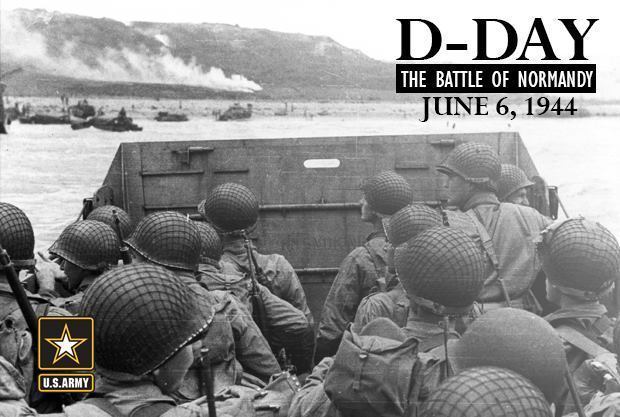
D-Day: The battle of Normandy, June 6, 1944
U.S. Army graphic by Daniel Torok
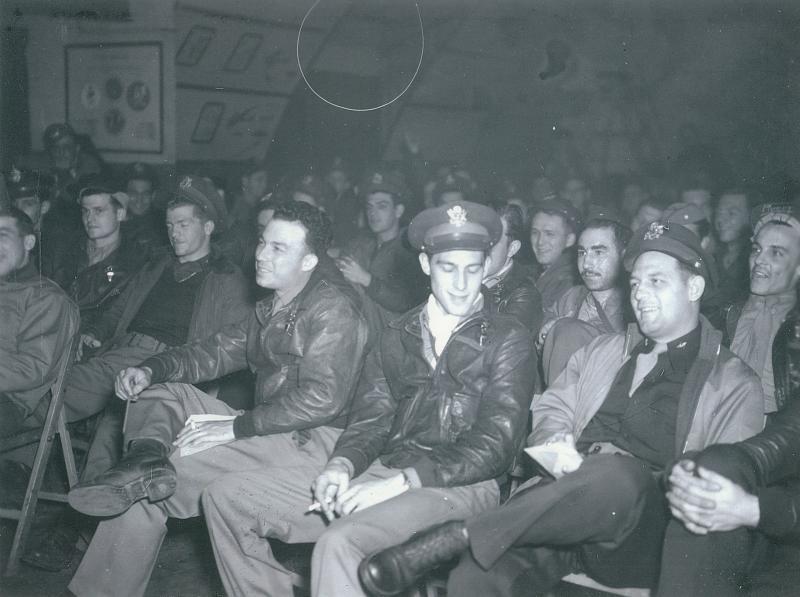
Lt. Col. Roy A. Webb Jr., second from right, commander of the 374th Fighter Squadron, receives a flight briefing prior to flying a mission on June 6, 1944 – the day of the D-Day invasion. Pictured at Bottisham air field in England are 374th pilots Lt. Wallace B. Frank, Lt. Col. Wallace E. Hopkins, Major George R. Rew, Capt. George Lichter, Lt. Col. Roy Webb, Lt. Edward Murdy. Briefing Room, Bottisham. (Photo from the collection of the American Air Museum in England)
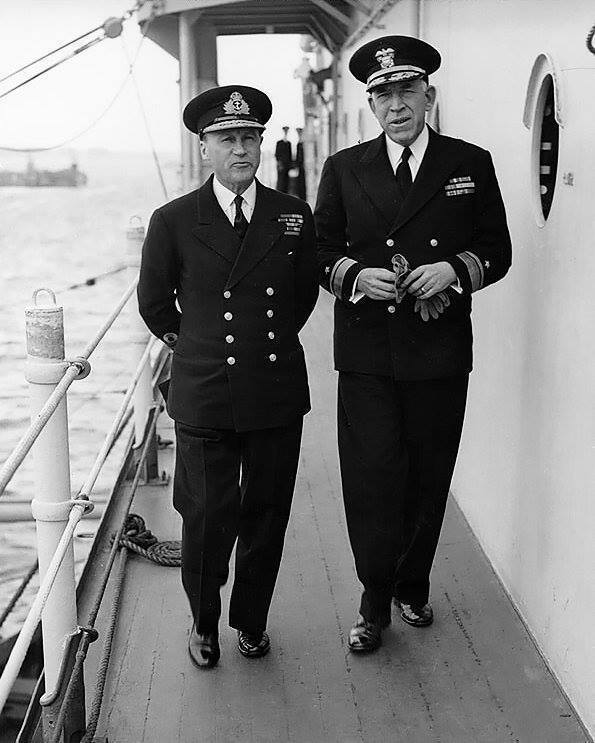
British Royal Navy Adm. Sir Bertram Ramsay, left, talks with U.S. Navy Rear Adm. John L. Hall Jr. aboard the command ship USS Ancon (AGC 4) May 25, 1944, at an unknown location. On May 28, 1944, Ramsay issued the order to carry out Operation Neptune, the amphibious portion of the invasion of Normandy. The morning of June 6, 1944, Allied forces conducted a massive airborne assault and amphibious landing in the Normandy region of France. The invasion marked the beginning of the final phase of World War II in Europe, which ended with the surrender of Germany the following May. (U.S. National Archives and Records Administration photo/Released)
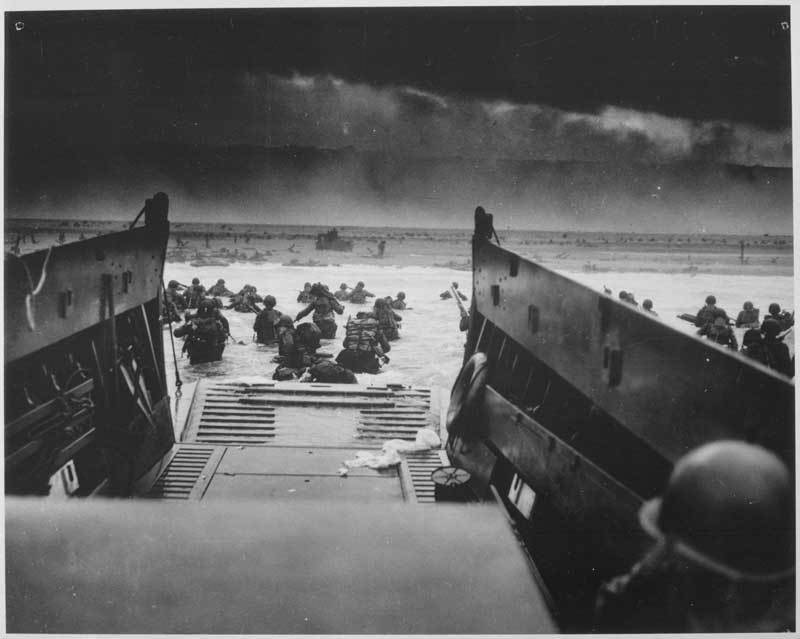
U.S. Soldiers disembark a landing craft under heavy fire off the coast of Normandy, France, June 6, 1944. (Photo Credit: National Archives U.S. Coast Guard Collection)
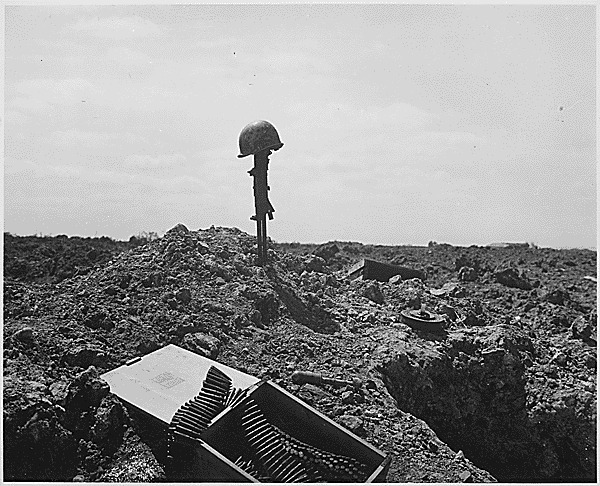
The beachhead is secure, but the price was high. A U.S. Coast Guard photographer came upon this monument to a dead American soldier somewhere on the shell-blasted shore of Normandy shortly after D-Day. Coast Guard photo
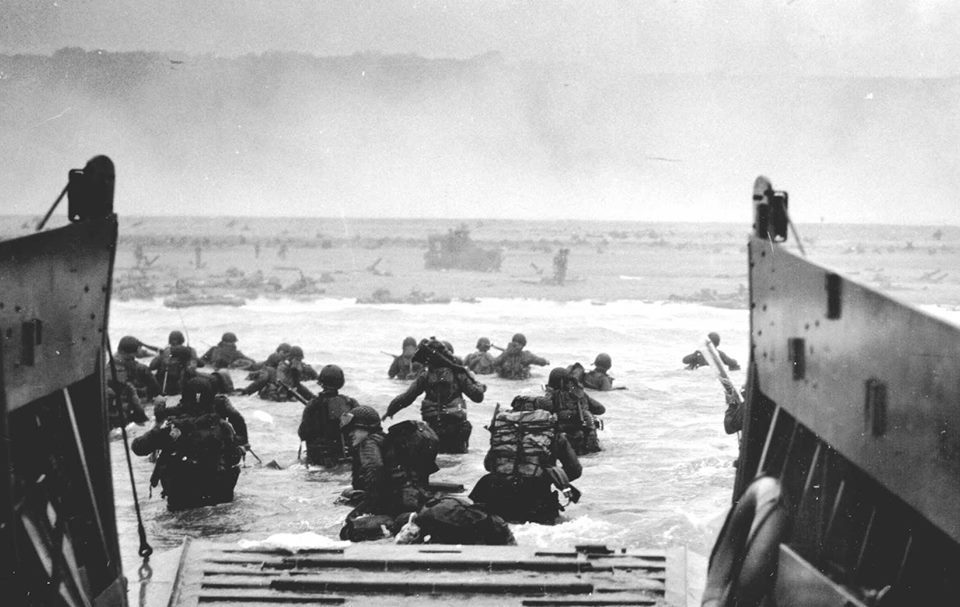
U.S. Soldiers disembark a landing craft at Normandy, France, June 6, 1944. By the end of the day, some 150,000 Allied troops had landed on five Normandy beaches and three airborne drop zones. The invasion marked the beginning of the final phase of World War II in Europe, which ended with the surrender of Germany the following May. (DOD photo courtesy of the National Infantry Museum/Released)
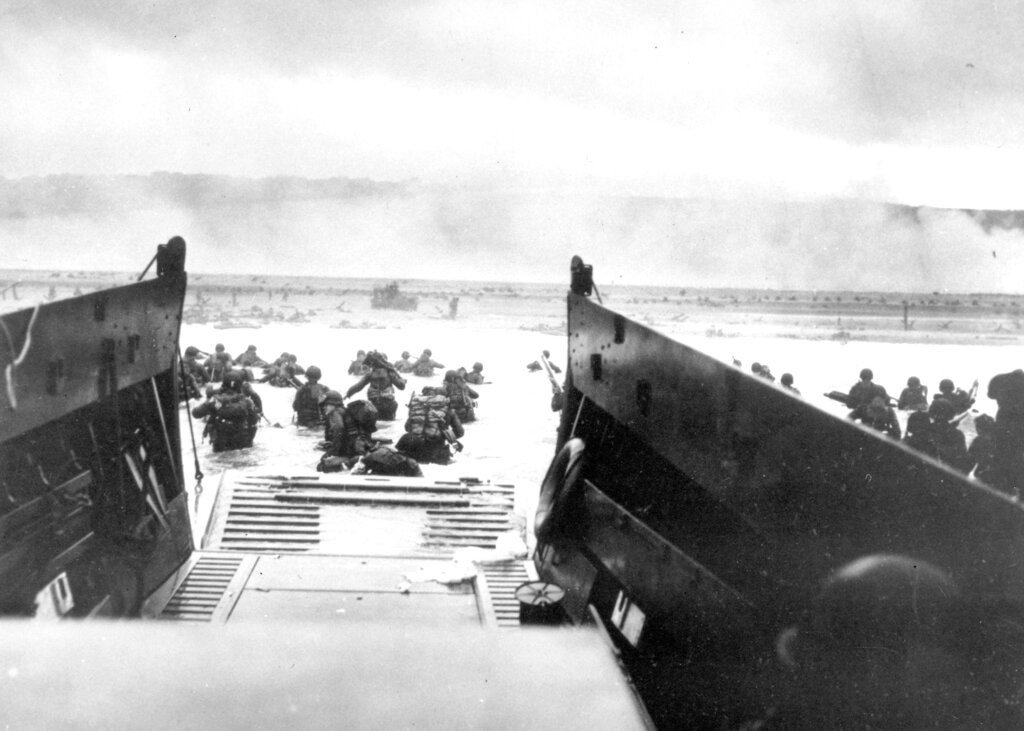
FILE – In this June 8, 1944, file photo, under heavy German machine gun fire, American infantrymen wade ashore off the ramp of a Coast Guard landing craft during the invasion of the French coast of Normandy in World War II.(U.S. Coast Guard via AP, File)
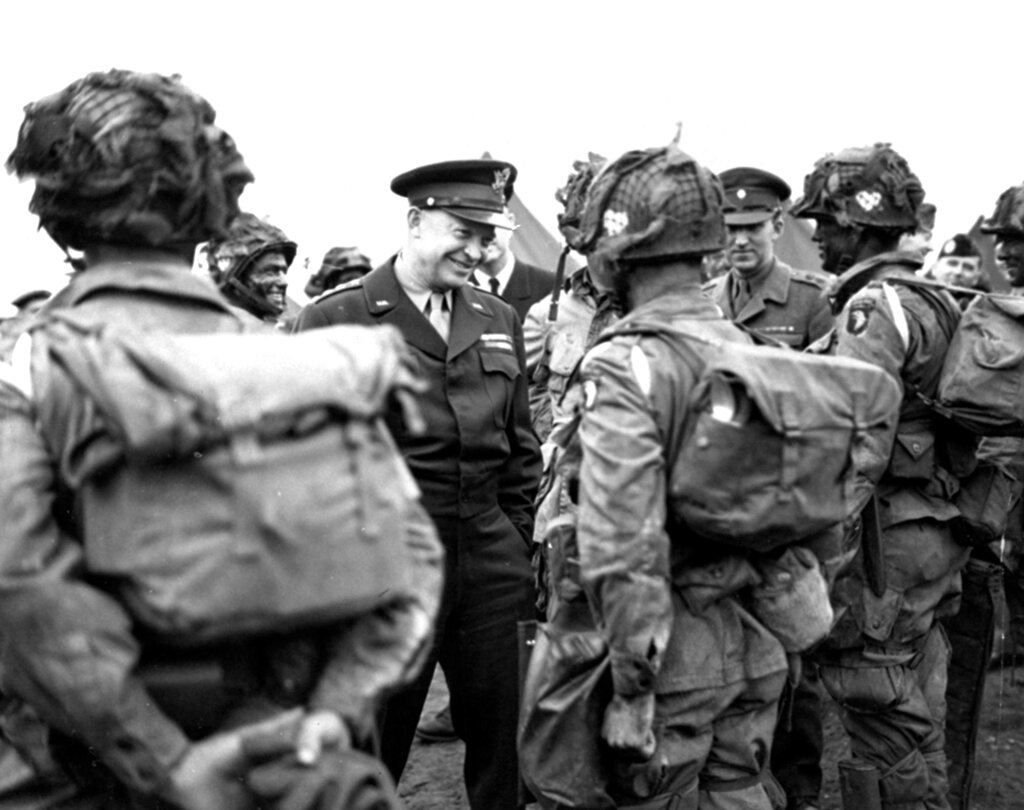
FILE – In this June 6, 1944, file photo, provided by the U.S. Army Signal Corps, General Dwight Eisenhower gives the order of the day, "Full Victory – Nothing Else" to paratroopers in England just before they board their planes to participate in the first assault in the invasion of the continent of Europe. June 6, 2019, marks the 75th anniversary of D-Day, the assault that began the liberation of France and Europe from German occupation, leading to the end World War II. (U.S. Army Signal Corps Photo via AP)
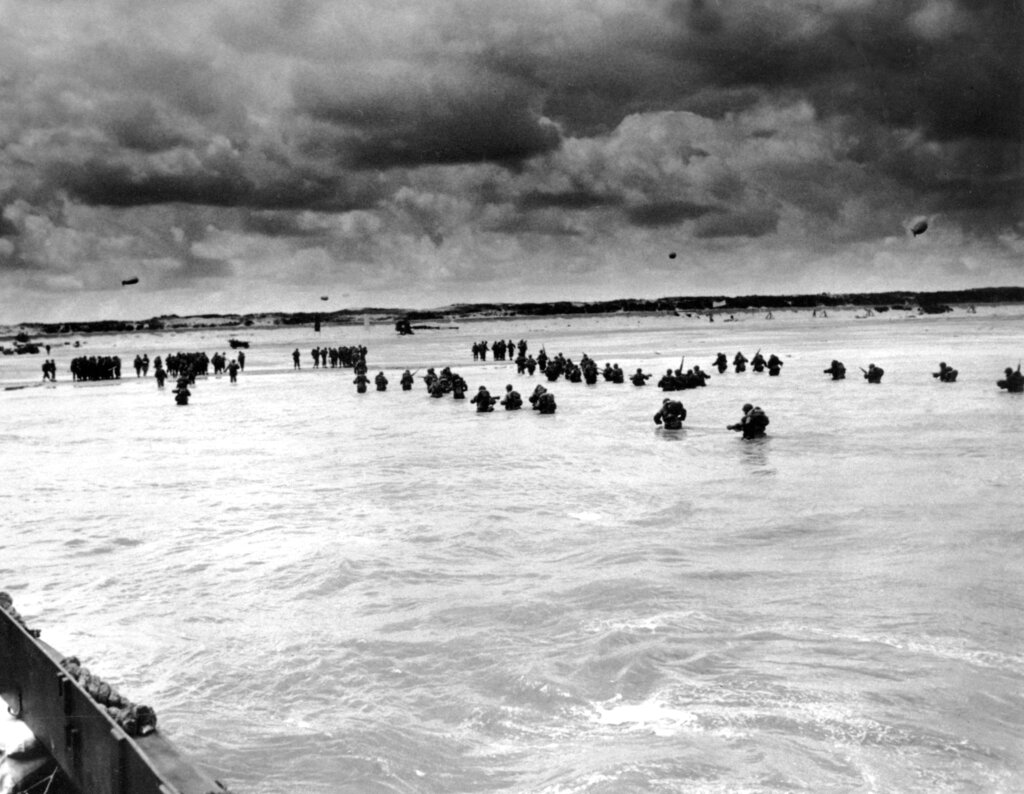
FILE – In this June 1944, file photo, U.S. reinforcements wade through the surf as they land at Normandy in the days following the Allies’, D-Day invasion of occupied France.(U.S. Coast Guard via AP, File)

FILE – In this June 5, 1944, file photo, U.S. serviceman attend a Protestant service aboard a landing craft before the D-Day invasion on the coast of France. (AP Photo/Pete J. Carroll, File)
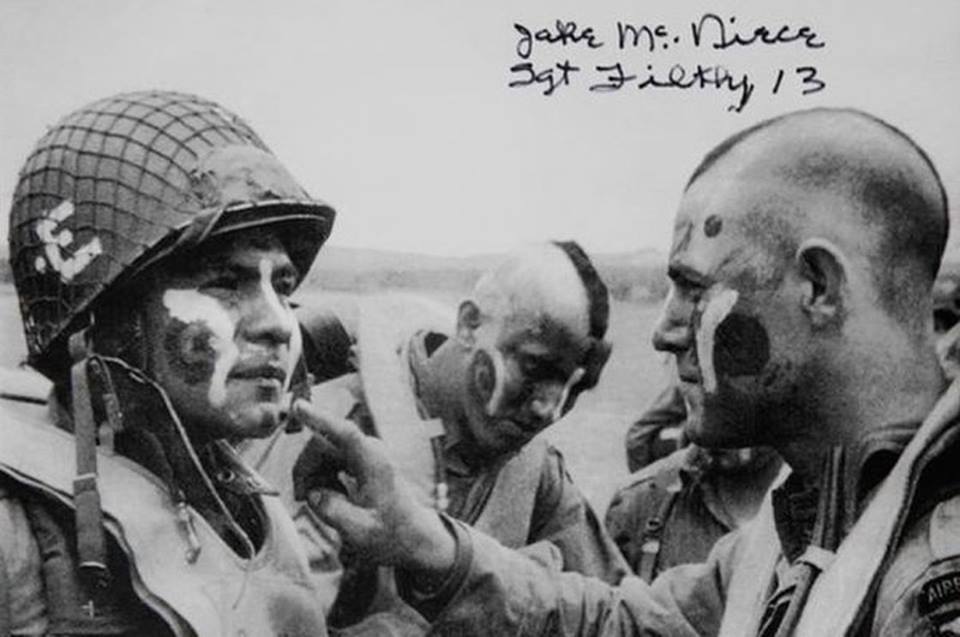
U.S. Soldiers, including Jake McNiece, right, assigned to the 101st Airborne Division apply war paint to each other’s face in England June 5, 1944, in preparation for the invasion of Normandy, France, the next day. The morning of June 6, 1944, Allied forces conducted a massive airborne assault and amphibious landing in the Normandy region of France. The invasion marked the beginning of the final phase of World War II in Europe, which ended with the surrender of Germany the following May. McNiece led a demolition group called the Filthy 13, whose exploits were credited with the inspiration of the film "The Dirty Dozen." (U.S. Army photo/Released)
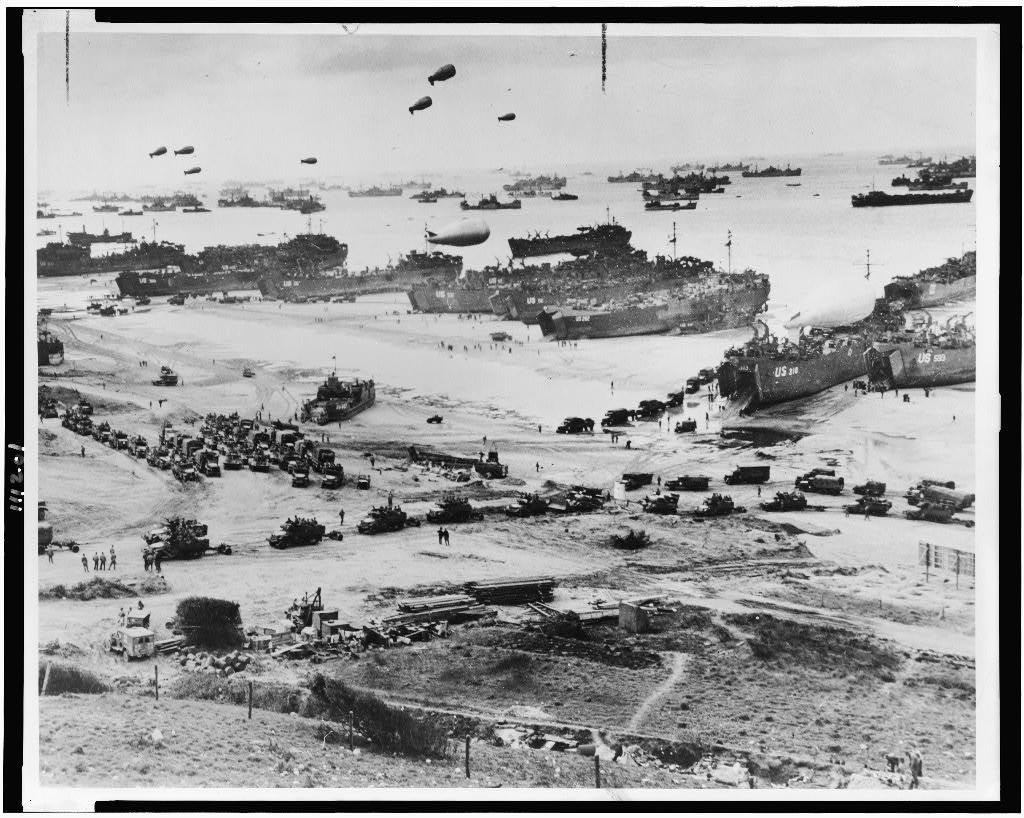
A bird’s-eye view of landing craft, barrage balloons and Allied troops landing in Normandy, France, on D-Day, June 6, 1944. U.S. Maritime Commission photo
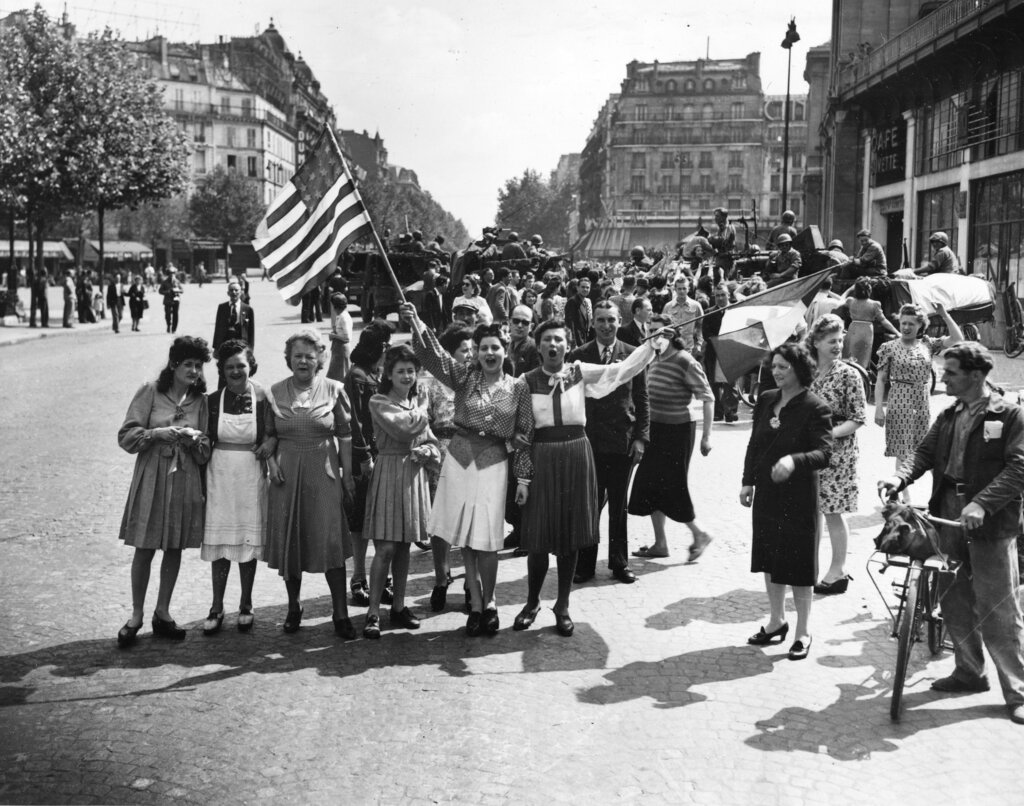
FILE – In this Aug. 25, 1944 file photo, French civilians with hastily made American and French flags greet U.S. and Free French troops entering Paris, France, after Allied liberation of the French capital from Nazi occupation in World War II. For Allied troops in western Europe, D-Day was just the beginning of a long and bloody push toward victory over the Nazis. (AP Photo/Harry Harris, file)
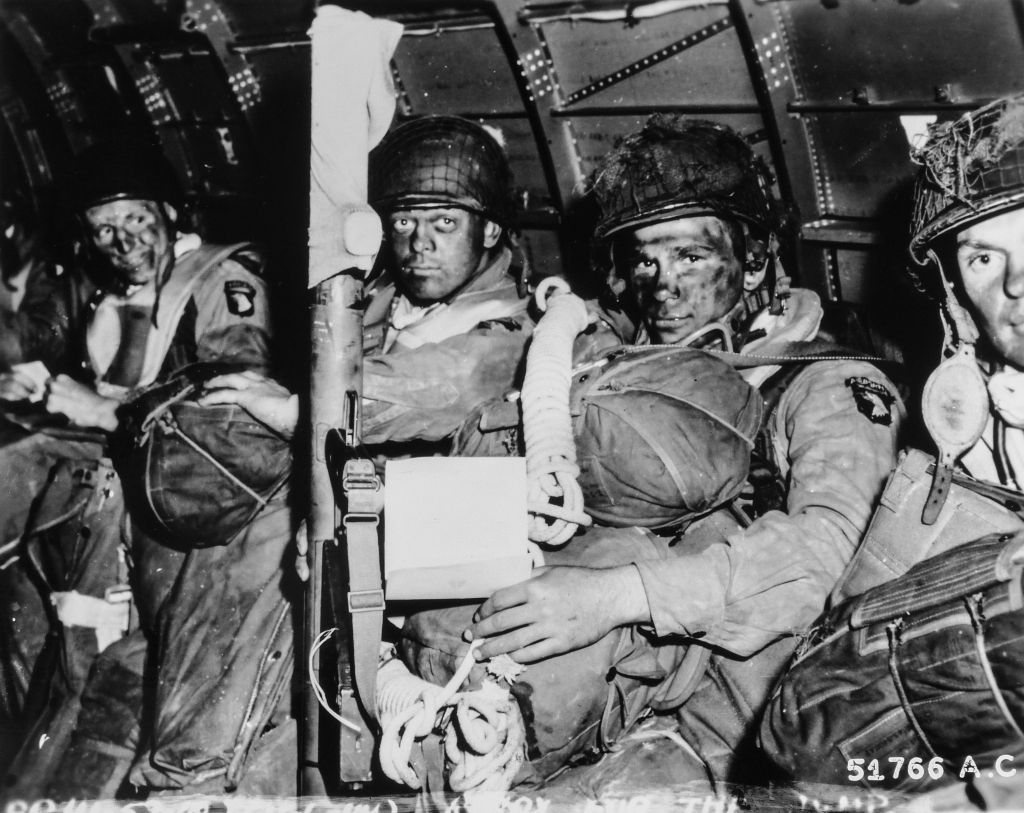
Resolute faces of U.S. Army paratroopers just before they took off for the initial assault of D-Day. The paratrooper in the foreground had just read Gen. Dwight D. Eisenhower’s message of good luck and clasped his bazooka in determination. Note Eisenhower’s D-Day order in the hands of the paratrooper in the foreground. DOD photo
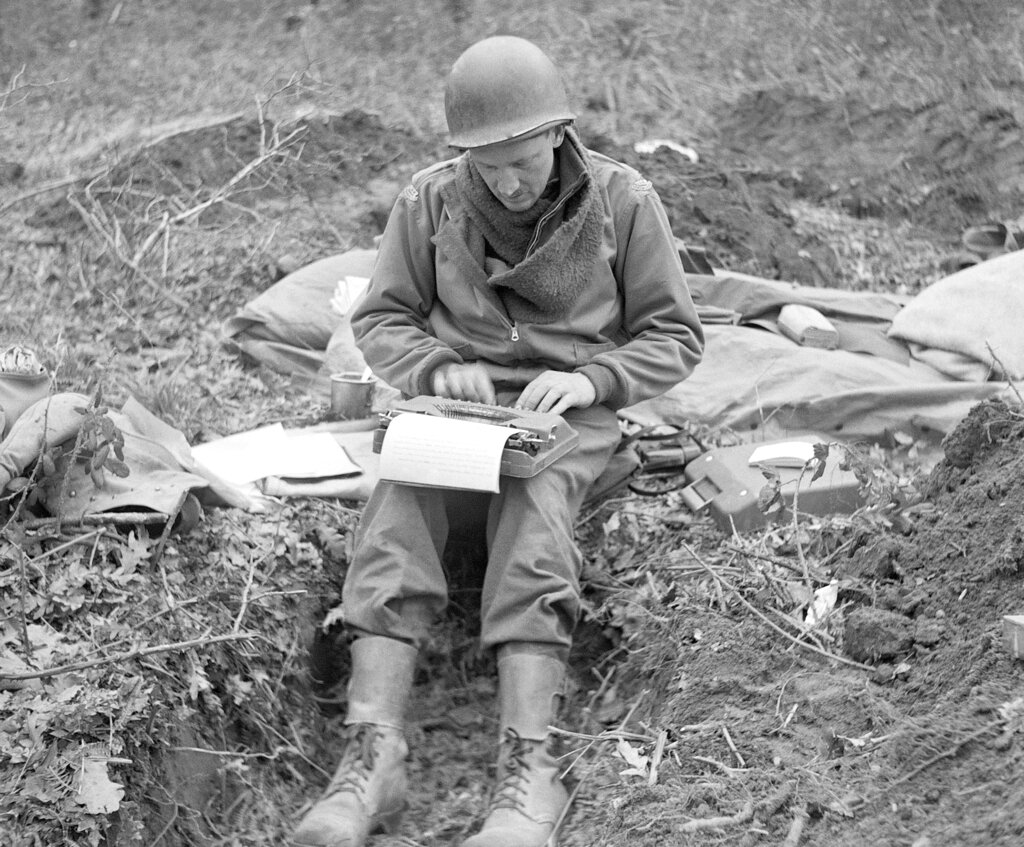
FILE – In this February 1944, file photo, Don Whitehead, Associated Press correspondent, writes his story of the landing at Anzio Beach in Italy, from a fox hole. Whitehead, known by his colleagues as “Beachhead Don,” returned to Normandy for the tenth anniversary of the D-Day invasion, June 5, 1954, which he covered when he followed the 1st Infantry Division onto Omaha Beach. (AP Photo/Bill Allen, File)
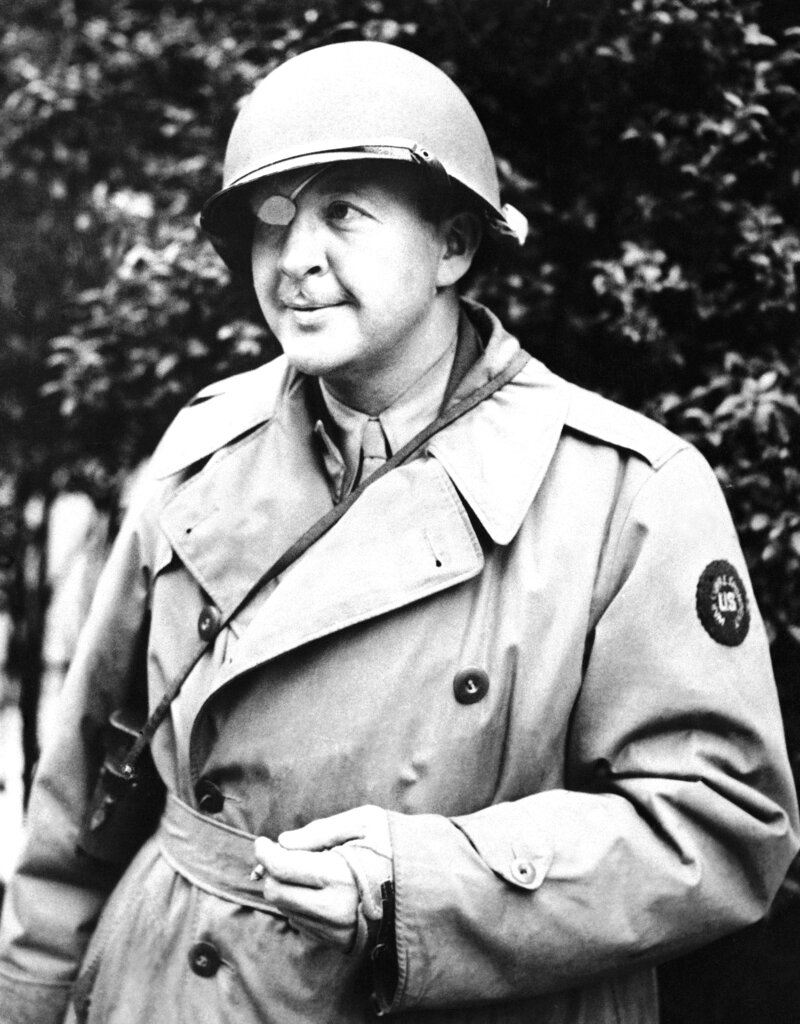
This undated photo shows Associated Press reporter Roger Greene a few days after the June 6, 1944, D-Day landing in France. Greene was the first seaborned war correspondent to land on the beach of Normandy in the D-Day invasion. He accompanied British forces across the Channel. (AP Photo)
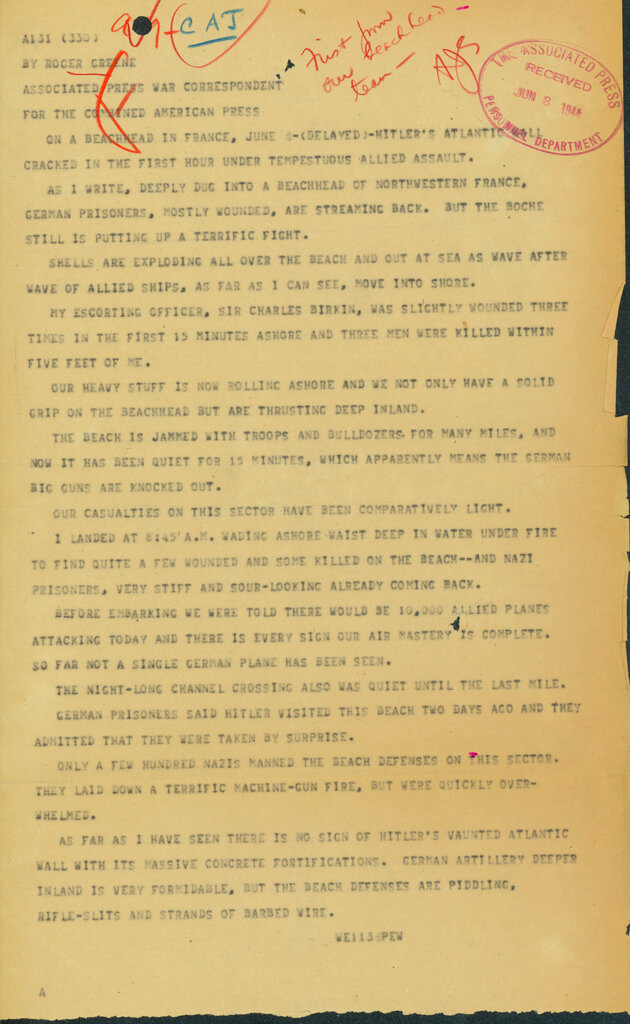
This wire copy by Associated Press reporter Roger Greene reached New York on June 8, 1944, two days after Greene made the D-Day landing alongside British forces. Greenes escorting officer was wounded and he saw three men killed as he landed. In New York Executive Editor Alan J. Gould marked the copy in red, First from our beachhead team. (AP Photo/AP Corporate Archives)
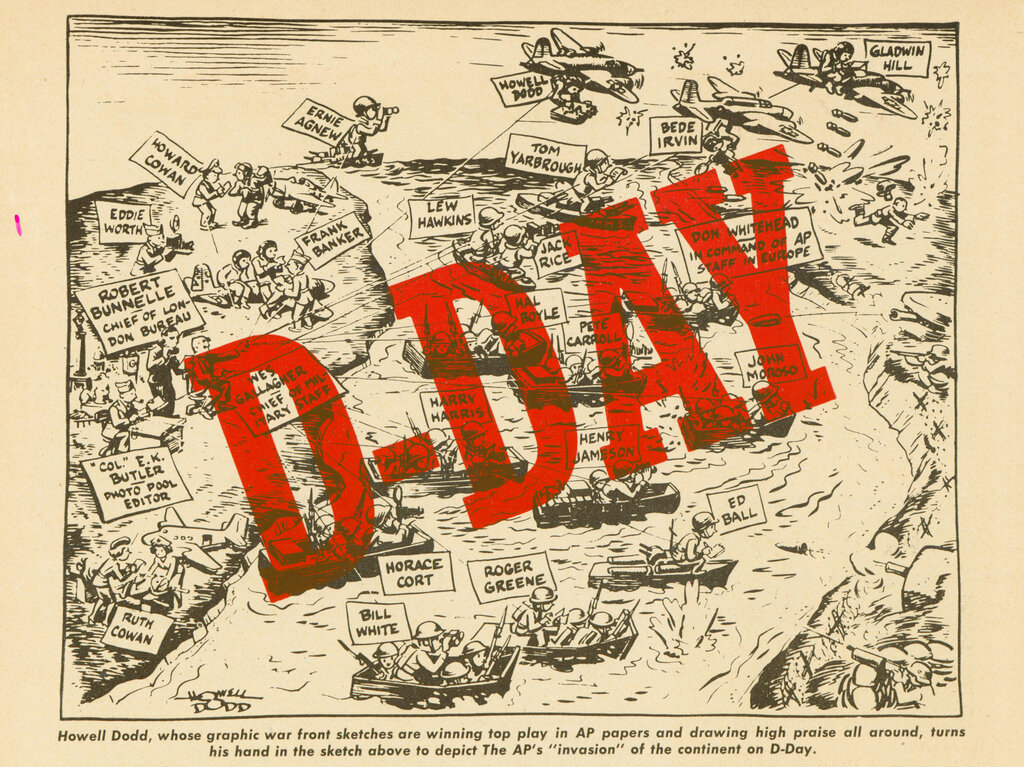
This undated image shows the Howell Dodd graphic that appeared in the June-July 1944 issue of The AP Inter-Office, a printed and illustrated magazine that was offered to AP staff and member newspapers. The graphic shows depictions of the AP correspondents on D-Day. In 1945 the magazine changed its name to AP World. (AP Photo/AP Corporate Archives, Howell Dodd)


