Texas has numerous ghost towns, some with ruins, cemeteries, or markers preserving their histories.
Many ghost towns declined due to factors like bypassing railroads, changing economies, and natural disasters.
Visiting Texas ghost towns offers a glimpse into the state's rich history and abandoned settlements.
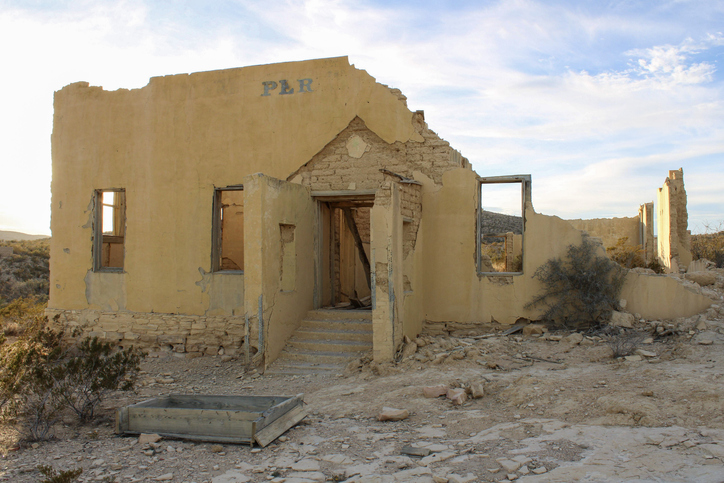
Source: Terlingua, Texas, is a captivating ghost town nestled deep in the Chihuahuan Desert of the Big Bend region. Once a bustling mercury mining community, its authentic ruins and weathered buildings tell tales of a forgotten past. (Eric Heroux via Getty Images)
25 Texas Ghost Towns You Can Still Visit
Texas is full of places that used to be something.
Some were ports, mining towns, railroad stops or small communities that faded after storms, droughts, highways or changing times passed them by.
Today, many of those places are known as ghost towns. Some still have ruins standing, while others are remembered by cemeteries, markers or lonely backroads.
For anyone who loves Texas history, road trips or forgotten places, here are 25 Texas ghost towns.
Before visiting any ghost town, check access rules, respect private property and do not enter unsafe buildings. Some of these places are best experienced through historical markers, cemeteries, ruins or nearby public roads.
1. Terlingua — Brewster County
Status: Historic Ghost Town / Tourist Community Distance from Houston: About 620 miles
About: Terlingua is probably the Texas ghost town most people know by name. Founded in 1899, the mining community grew around quicksilver production, but when the Chisos Mining Company filed for bankruptcy in 1942 and operations ended after World War II, most residents scattered. Tourism later gave Terlingua a second life.
2. Glenrio — Deaf Smith County
Status: Abandoned Site / Historic District Distance from Houston: About 665 miles
About: Founded in 1906, Glenrio was once a Route 66 stop right on the Texas-New Mexico line. The town grew with the railroad and later served highway travelers, but its run faded after Interstate 40 bypassed it in 1975. Today, its historic district includes the old roadbed and several abandoned buildings.
3. Indianola — Calhoun County
Status: Barren Site / Historic Marker Distance from Houston: About 155 miles
About: Indianola was once one of the most important ports in Texas. Founded in 1846, the town became Calhoun County’s seat and grew into a major Gulf Coast entry point, but hurricanes changed everything. After devastating storms in 1875 and 1886, Indianola was abandoned by 1887.
4. Thurber — Erath County
Status: Semi-Abandoned Site / Historic Ghost Town Distance from Houston: About 310 miles
About: Thurber was a late 1880s coal town that once ranked among the busiest industrial communities in Texas. At its peak around 1918-20, it may have had 8,000 to 10,000 people. When locomotives shifted from coal to oil, the town declined and was a virtual ghost town by the late 1930s.
5. Helena — Karnes County
Status: Historic Community / Semi-Abandoned Site Distance from Houston: About 200 miles
About: Helena was founded in 1852 and became the Karnes County seat in 1854. It was once a rough-and-busy South Texas town, but its future changed when the railroad bypassed it and county business shifted elsewhere. Today, Helena is best remembered as a historic ghost town.
6. Fort Griffin — Shackelford County
Status: Neglected Site / State Historic Site Distance from Houston: About 360 miles
About: In the late 1860s Fort Griffin grew near the military post of the same name and became one of the wild frontier towns of Texas. Buffalo hunters, soldiers, gamblers and outlaws all passed through. Once the buffalo trade faded, the fort closed in 1881 and the railroad favored Albany, the town quickly declined.
7. The Grove — Coryell County
Status: Historic Community Distance from Houston: About 205 miles
About: The Grove is not a barren ghost town, but it is one of those Texas places that feels frozen in time. Established around 1859, it was once a thriving community. Its decline began after State Highway 36 bypassed it in the 1940s, with Fort Hood and Belton Dam also changing the area.
8. Belle Plain — Callahan County
Status: Barren Site / Neglected Site Distance from Houston: About 370 miles
About: Belle Plain was established in 1876 and briefly became the Callahan County seat. The town looked promising, but when the railroad bypassed it and Baird became county seat in 1883, its future dimmed fast. Drought, hard winters and population loss finished what the railroad started.
9. Texana — Jackson County
Status: Barren Site Distance from Houston: About 105 miles
About: Texana was founded in 1832 and once served as an important early Texas settlement and county seat. It was still a thriving port in the early 1880s, but the railroad bypassed it in 1883. Residents and businesses moved to nearby Edna, and Texana was a virtual ghost town by 1884.
10. Saluria — Calhoun County
Status: Barren Site Distance from Houston: About 170 miles
About: Saluria, founded in 1847, once stood on Matagorda Island and served as a Gulf Coast port community. Its location made it vulnerable, and storms helped erase it. The 1875 hurricane devastated Saluria, and another hurricane in 1886 sealed its fate. This is not a typical drive-up ghost town, so access should be checked first.
11. Clara — Wichita County
Status: Barren Site / Historic Marker Distance from Houston: About 410 miles
About: Clara was platted in 1886 by Herman Specht, who named the Wichita County town for his wife, Clara. Like many small Texas settlements, it never became a long-term population center. Today, Clara survives mostly through its historical marker and local church history, making it more of a roadside history stop.
12. Monte Christo — Hidalgo County
Status: Barren Site Distance from Houston: About 360 miles
About: Monte Christo was founded in 1909 by the Melado Land Company of Houston and briefly had a railroad siding, post office, hotel, stores and farm families. Then reality hit. A failed well, lack of water and border raids in 1915-16 pushed residents away. The post office closed in 1920.
13. Swartwout — Polk County
Founded: 1838 Status: Barren Site / Inundated Site Distance from Houston: About 75 miles
About: Swartwout was laid out in 1838 near the Trinity River and once had a ferry, landing, hotel and warehouses. Railroads later reduced river traffic, and the old townsite was eventually washed away. A marker was moved after the Livingston Reservoir inundated the original area.
14. Kilraven — Cherokee County
Founded: About 1900 Status: Barren Site Distance from Houston: About 145 miles
About: Kilraven was a sawmill community that developed just before 1900 and took the Kilraven name in 1909. Like many East Texas mill towns, it depended on one industry. When the mill closed in the early 1920s, most residents moved on. By the 1990s, only the mill pond remained.
15. Knoxville — Cherokee County
Founded: Late 1840s Status: Barren Site / Cemetery Site Distance from Houston: About 165 miles
About: Knoxville started with settlers from Tennessee in the late 1840s and grew enough to have a post office by 1854. Its decline came when the railroad bypassed the community in the early 1870s. Businesses and residents moved to Troup, the post office closed in 1875 and Knoxville became a ghost town soon after.
16. Lodi — Wilson County
Status: Neglected Site / Ruins Distance from Houston: About 205 miles
About: Lodi traces back to a hacienda established before 1832 and became the first settlement in what is now Wilson County. It even served as county seat for a time. After losing county-seat status and seeing activity move elsewhere, the town declined. By 1940, only ruins of the hacienda and church remained.
17. Union — Wilson County
Status: Historic Community / Semi-Abandoned Site Distance from Houston: About 195 miles
About: Union grew around a post office established in 1883 and had stores, a saloon, church, mill, cotton gin and other businesses by the 1890s. It was not fully abandoned, but it faded hard after the post office closed in 1915 and the community declined through the 1920s and 1930s.
18. Wintergreen — Karnes County
Status: Barren Site Distance from Houston: About 180 miles
About: Wintergreen is one of the more obscure Texas ghost towns, which makes it interesting but also harder to build out. The settlement appeared on maps from 1858 to 1868 near the old Victoria-San Antonio and Helena-Gonzales roads. Today, it no longer exists as an active community.
19. Aransas City — Aransas County
Status: Barren Site Distance from Houston: About 200 miles
About: Aransas City was founded about 1837 by James Power on Live Oak Point and briefly became one of the most important early ports in Texas. It served as a Refugio County government center and Republic of Texas customhouse site, but competition from other ports, county-seat changes and repeated attacks doomed it. By 1847, Aransas City had ceased to exist.
20. Veal’s Station — Parker County
Status: Historic Community / Semi-Abandoned Site Distance from Houston: About 310 miles
About: Veal’s Station began in the 1850s and had postal service by 1857. It became a small farming center north of Weatherford, but its growth stalled after railroads bypassed it. The post office closed in 1906, and the community faded into a historic stop rather than a thriving town.
21. Nashville — Milam County
Status: Barren Site / Historic Marker Distance from Houston: About 120 miles
About: Nashville, also known as Nashville-on-the-Brazos, was founded in 1835 by Sterling C. Robertson and served as headquarters for Robertson’s colony. It was even considered as a possible Texas capital after the Revolution. Once Cameron became county seat in 1846 and the railroad boosted nearby Hearne in 1868, Nashville faded away.
22. Belzora — Smith County
Status: Barren Site / Historic Marker Distance from Houston: About 215 miles
About: Belzora started as a ferry crossing and stage stop near the Sabine River in 1850. The town had big ambitions tied to river traffic, but those plans never really worked. After the International-Great Northern Railroad came through Smith County, Belzora declined. By 2004, only a historical marker remained.
23. Science Hill — Henderson County
Status: Barren Site / Cemetery Site Distance from Houston: About 185 miles
About: Science Hill began with settlers arriving in 1846 and later had a post office, academy, cemetery and Masonic lodge. Its institutions slowly disappeared in the late 1800s. The academy closed in 1872, the lodge surrendered its charter in 1878, and by 1936 there was nothing left to identify the site.
24. Grand Cane / Clark — Liberty County
Status: Barren Site / Former Community Distance from Houston: About 70 miles
About: Grand Cane has a major Texas history connection. Sam Houston established a family home there in 1842, and the Grand Cane post office was established in 1846. The area later went by Ironwood and Clark, but by 1990 only scattered buildings and a gravel pit marked the old site.
25. Mount Gainor — Hays County
Status: Barren Site / Historic Marker Distance from Houston: About 190 miles
About: Mount Gainor was a small school and church community in western Hays County. From 1872 to 1879, it also had a post office. It served as a late-1800s social center, but never grew into a lasting town. Today, it no longer exists as an active community and is remembered by marker history.